how-to
Permanent Lighting Installation for Oakland County Homes
Editorial Team · Nov 11, 2026 · 10 min read
Last Updated: November 10, 2026
Quick Summary
Permanent lighting is a fixed, app-controlled LED system mounted under the eaves that stays on the house year-round and changes color or brightness on command. For Oakland County homes, one professional install replaces seasonal string lights, so you skip the ladder work, storage bins, and brittle clips that Michigan winters ruin.
- Installers walk the roofline and record measurements before mapping fixtures, spacing, and zones.
- Fixtures mount with clips or channel, with no drilling through the fascia face.
- Confirm permit and electrical requirements for your specific address with your local building department.
- Rinse fixtures with a garden hose a few times a year to clear pollen and grit.
- Use warm white at low brightness for everyday curb appeal and save color for occasions.
Table of Contents
- Why Permanent Lighting Fits Oakland County Homes and Businesses
- How Permanent Roofline Lighting Is Planned and Installed
- What Drives Permanent Lighting Installation Cost
- How to Choose a Permanent Lighting Installer
- Permits, Electrical Safety, and Local Rules to Check First
- Permanent LED Lighting Maintenance and Troubleshooting
- Design, Color, and Everyday Use for Homes and Storefronts
- Preview Your Lighting Design Before You Commit
- Frequently Asked Questions
Why Permanent Lighting Fits Oakland County Homes and Businesses
Permanent lighting installation for Oakland County properties solves a problem most homeowners know too well: hauling out ladders every November, untangling strings of bulbs, and hoping the clips hold through a Michigan ice storm. Permanent concealed LED fixtures along the roofline can be installed once and then controlled from a phone all year.
Permanent lighting is a fixed, app-controlled LED system mounted under the eaves that stays on the house year-round and changes color or brightness on command. It replaces seasonal string lights with a single professional install.
Why it fits this market:
- Michigan winters punish temporary lights. Cold snaps crack plastic clips and brittle wire.
- One install covers Christmas, game days, graduations, and quiet architectural white the rest of the year.
- No takedown, no storage bins in the garage, no spring removal.
The trade-off is upfront cost versus years of repeat labor. For most properties, the math favors permanent.
How Permanent Roofline Lighting Is Planned and Installed
Good permanent roofline lighting starts with measurement, not a ladder and a guess. A typical project runs through a repeatable sequence: walk and measure, map fixtures and zones, plan the power and wire path, mount and connect, then test and commission. Skipping or rushing any step is what produces dark gaps, flickering zones, and callbacks.
Step 1: Walk the Roofline and Record Measurements
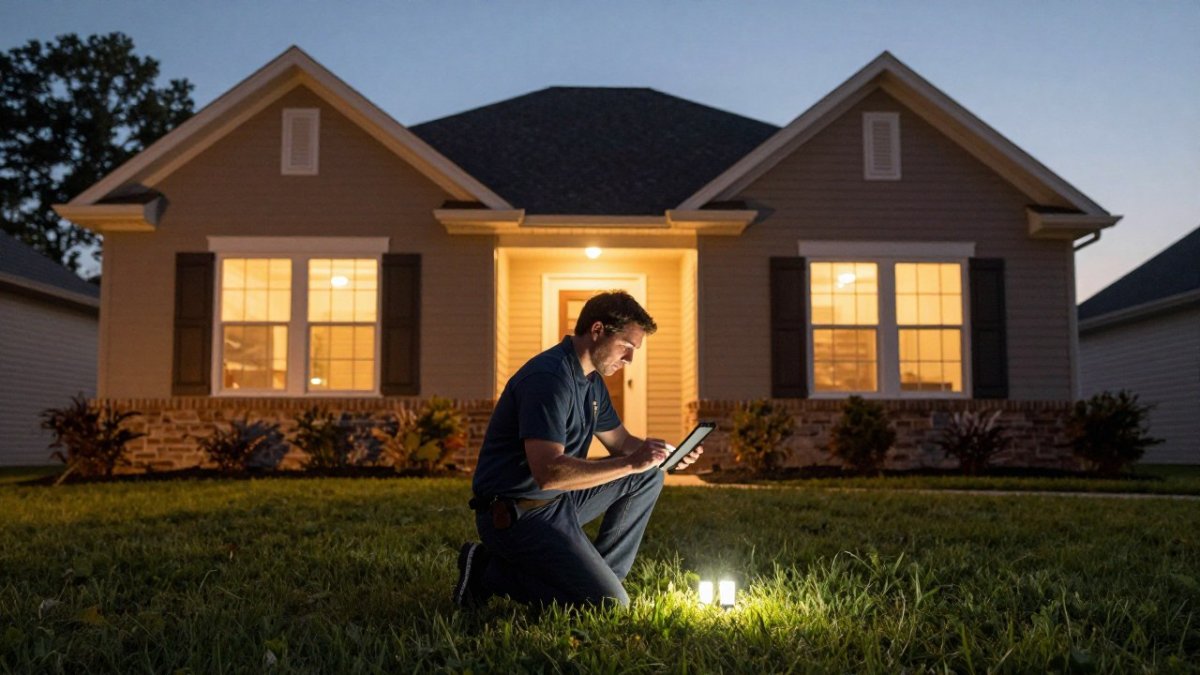
The installer walks the full perimeter at ground level first, then confirms details up close. Record linear feet for each run, every inside and outside corner, gable peaks, dormers, valleys, and soffit depth. Note roof pitch and story height, because both change access and labor. Photograph each elevation so the plan can be checked later against the finished run.
Step 2: Map Fixtures, Spacing, and Zones
Two fixture families are commonly used on homes: discrete puck lights spaced along the roofline for a scalloped look, or continuous LED strip in a concealed track for one unbroken line.
Step 3: Plan the Power Source and Wire Path
Low-voltage wiring runs in the soffit or attic and connects to a controller. Identify where the controller will live (often near an existing exterior outlet or in the garage), how the low-voltage run reaches it, and whether any line-voltage connection is needed. Any 120-volt work should be handled by a licensed electrician and coordinated with the rest of the schedule, not improvised on install day.
Step 4: Mount, Connect, and Conceal
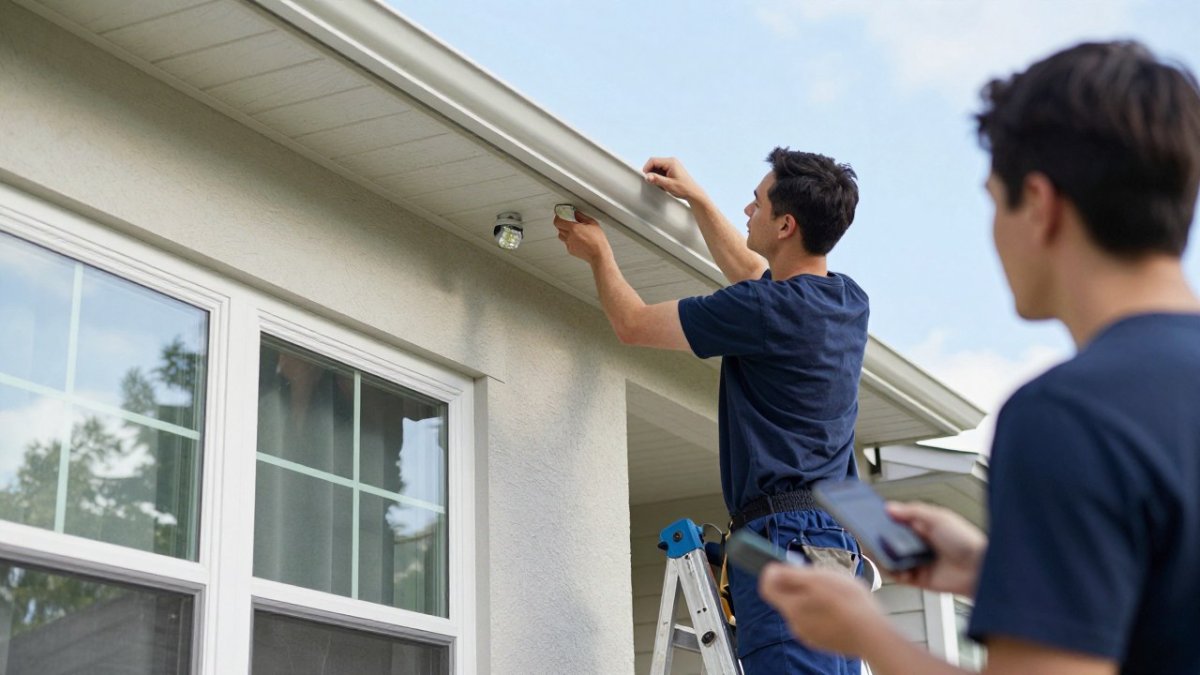
Fixtures mount with clips or channel, no drilling through the fascia face. The crew works one elevation at a time, keeping wire tucked and drip loops where water can run. Connectors get seated fully and strain-relieved so ice and wind do not pull them loose. Concealment matters as much as the light: the fixtures should read as part of the soffit line, not as hardware bolted to the house.
Step 5: Test, Commission, and Hand Off
Watch out: skipping the measurement walk is the most common shortcut. Fixtures spaced by eye leave dark gaps that no app setting can fix, and a rushed commissioning leaves the homeowner unable to diagnose a simple zone outage later.
A typical permanent roofline lighting project follows a repeatable five-step sequence.
| Step | What to do |
|---|---|
| Step 1 | Walk the roofline and record measurements |
| Step 2 | Map fixtures, spacing, and zones |
| Step 3 | Plan the power source and wire path |
| Step 4 | Mount, connect, and conceal |
| Step 5 | Test, commission, and hand off |
What Drives Permanent Lighting Installation Cost
Permanent lighting installation cost depends on several factors, and pricing varies by project. For current pricing or a quote, contact Curb Appeal Permanent Lights directly.
Request a written quote from Curb Appeal Permanent Lights for current pricing.
How to Choose a Permanent Lighting Installer
Choosing a permanent lighting installer involves comparing several factors, not just price. Before signing, consider asking about:
- The warranty terms and what they cover
- Whether the installer handles service calls and repairs
- The electrical licensing held by the installer or the electrician they work with
- How fixtures are attached to the home
- A written quote that itemizes costs
- Whether the service area covers your address
When you are ready to move, you can request your estimate with your property details and any design preview you have generated.
Permits, Electrical Safety, and Local Rules to Check First
Permit and electrical rules vary by township and county, so confirm the requirements for your specific address with your local building department before work begins.
Know Which Side of the Line You Are On
Permanent lighting systems are often low-voltage, and whether a permit is required depends on the work involved. Line-voltage work, such as adding a circuit or tying a controller into household wiring, typically requires a licensed electrician. Ask the installer to confirm which category your project falls into.
How to Verify Requirements for Your Address
- Call or check the website of your local building department and ask whether an electrical permit is required for the controller and any line-voltage connection.
- Ask whether the installer is licensed for any 120-volt work, and who pulls the permit if one is needed.
- Check whether a homeowner association has rules on exterior lighting color, brightness, or overnight operation.
- Check whether local outdoor lighting standards limit light spill or glare toward neighbors.
- Ask whether the crew carries insurance and can provide a certificate before work starts.
Electrical Safety Checks That Matter
- Ask whether the power source is GFCI-protected where required for exterior circuits.
- Ask whether connections are rated for outdoor use and protected from water intrusion.
- Ask whether the controller and transformer are sized for the connected fixture load.
- Ask how the system is grounded and whether any line-voltage junction is accessible for inspection.
Permanent LED Lighting Maintenance and Troubleshooting
Permanent LED lighting maintenance is generally minimal, though it is not zero. Periodic cleaning and an occasional app check are typical.
Routine care:
- Rinse fixtures with a garden hose a few times a year to clear pollen and grit
- Check the app after storms to confirm schedules and scenes still run
- Note any flickering zone and report it early, before a whole run fails
Common fixes:
- Lights not responding: check the controller power and Wi-Fi connection first
- One zone dark: usually a single fixture or connector, not the whole system
- Color drift: re-sync the scene in the app
Ask whether the installer offers a written warranty and on-call service, and what the response time is for a repair call, before you buy.
Design, Color, and Everyday Use for Homes and Storefronts
Design choices decide whether permanent lights read as elegant or overdone. The best installs use warm white most nights and save color for occasions.
For homes:
- Warm white at low brightness for everyday curb appeal
- Holiday scenes for December, team colors for game days
- Soft accents along gables rather than full-brightness color year-round
For storefronts and commercial properties:
- Consistent brand colors during business hours
- Seasonal scenes tied to promotions
Traditional homes can suit permanent lighting when the fixtures stay concealed and the default scene is a subtle warm white. App-controlled schedules can also help manage when lights run.
Preview Your Lighting Design Before You Commit
The biggest fear with any exterior upgrade is committing to a look you end up disliking. A design preview removes most of that risk before a single fixture is mounted.
Curb Appeal Permanent Lights offers an online photo visualizer that lets you preview lighting on your own home.
Permanent exterior lighting is a long-term decision, and the wrong installer turns it into a repair bill. Curb Appeal Permanent Lights handles measurement, concealed fixture mounting, app configuration, and service after the install, with a photo visualizer so you see the design on your own home first. Get started with Curb Appeal Permanent Lights and replace the annual ladder work with lighting you control from your phone.
Frequently Asked Questions
How much does permanent lighting installation for Oakland County homes cost?
There is no single flat rate, and pricing varies by project. For current pricing or a quote, contact Curb Appeal Permanent Lights directly and request a written estimate.
Can permanent lights be used for holidays and everyday accent lighting?
Yes, and that is the main reason people choose them. The same system that runs warm white architectural lighting on an ordinary Tuesday can switch to red and green in December, team colors on game day, or soft amber for a fall open house. Schedules let the lights run when you want them. You set scenes in an app rather than climbing a ladder twice a year.
How long does permanent lighting installation take?
Project timelines vary with factors such as roofline length, roof pitch, and the number of stories. For the estimated duration of your project, contact Curb Appeal Permanent Lights for a written quote.
What are the downsides of permanent lights?
Upfront cost is higher than a one-time seasonal setup, and you need to be comfortable with an app or a simple remote. Lights can also affect neighbors if brightness is not set appropriately. These trade-offs are worth weighing against the annual takedown, storage, and repair cycle that temporary lights require.
