how-to
7 Permanent Holiday Lights Energy Facts That Cut Your Bill
Editorial Team · Nov 16, 2026 · 12 min read
Last Updated: November 15, 2026
Quick Summary
Permanent holiday lights use far less electricity than incandescent displays because they run on LED diodes, so most homes see only a modest bump in their monthly bill. Cost scales with run length, watts per foot, hours per night and your local rate, and a 150-foot run at 1 watt per foot costs roughly $35 per year on evening accent use.
- Most permanent LED fixtures are rated between 0.5 and 1.5 watts per foot, depending on LED density and brightness.
- A 100-foot run at 1 watt per foot costs about 8 cents per night at 16 cents per kWh.
- Dimming a run to 40% brightness can pull well below its rated wattage and lower real draw.
- Standby power from the controller draws a small amount every hour the lights are off.
- Size the power supply with headroom above the rated load to avoid flickering and early wear.
Table of Contents
- How Much Electricity Do Permanent Holiday Lights Actually Use?
- Permanent LED Holiday Lights Electricity Cost, Broken Down by Run Length
- LED Christmas Lights Electricity Usage vs. Incandescent Strands
- What Holiday Lights Cost to Run Across a Full Season
- Standby, Controller and Smart-Control Power You Might Not Count
- Why Energy-Efficient Holiday Lighting Changes the Year-Round Math
- Build Your Own Estimate Before You Commit to an Installation
- Frequently Asked Questions
How Much Electricity Do Permanent Holiday Lights Actually Use?
Permanent holiday lights energy consumption is lower than most homeowners expect, because the systems run on LED diodes rather than incandescent bulbs. A typical residential run draws a small fraction of what a traditional holiday display pulls. This guide breaks down the real numbers so you can estimate your own bill before you buy.
The short answer: most homes will see a modest bump in their monthly electric bill, not a shocking one. But the details matter, and most articles skip them.
Below, we'll show you exactly how to calculate your own cost using run length, hours per night, and your local rate. We'll also cover the two charges nobody warns you about: standby power and controller draw.
Rated Watts vs. Real Draw
Rated watts is the maximum a lighting system can pull at full brightness. Real draw is what it actually uses at your normal settings. The two are rarely the same.
Here's why that matters. LED technology lets you dim a run to 40% brightness for a subtle architectural glow. At that setting, the system pulls far less than its rated figure.
A common mistake is budgeting from the rated wattage on the box. In practice, most homeowners run their lights well below full output.
- Rated watts: the ceiling, used for sizing the power supply
- Real draw: what shows up on your meter
- Brightness setting: the biggest lever on real draw
- Color choice: white scenes typically draw less than saturated color mixes
So when you estimate, start with rated watts, then discount for how you'll actually run the system.
Permanent LED Holiday Lights Electricity Cost, Broken Down by Run Length
Cost scales with length. A longer roofline means more fixtures and more watts. That said, the per-foot draw of modern LED systems is low enough that even a large installation stays manageable.
Think in three variables:
- Total run length in feet
- Watts per foot for your chosen fixture
- Hours per night the system runs
Multiply length by watts per foot to get total watts. Divide by 1,000 for kilowatts. Multiply by hours and your electricity rate for the daily cost.
Most permanent LED fixtures are rated somewhere between 0.5 and 1.5 watts per foot, depending on LED density and brightness. That range is wide because a dense, high-output architectural channel letter draws more than a sparse accent run. Check the manufacturer's rated watts per foot for the exact fixture you're considering, and treat that as the ceiling rather than the typical draw.
Here's a worked example using a middle-of-the-road figure of 1 watt per foot and an illustrative residential rate of 16 cents per kilowatt-hour. Substitute your own utility rate:
- 100-foot run: 100 watts total. At 5 hours per night, that's 0.5 kWh per day, or about 8 cents per night. Over a 30-day month, roughly $2.40.
- 150-foot run: 150 watts total. At 5 hours per night, 0.75 kWh per day, about 12 cents per night, or $3.60 per month.
- 200-foot run: 200 watts total. At 5 hours per night, 1.0 kWh per day, about 16 cents per night, or $4.80 per month.
Double the length and you roughly double the draw. There's no hidden penalty for scale, but there is a hidden variable: brightness.
Watch out: undersizing the power supply to save money is a real risk. A supply that runs near its limit wears out faster and can cause flickering.
A transparent calculator beats a single example.
LED Christmas Lights Electricity Usage vs. Incandescent Strands
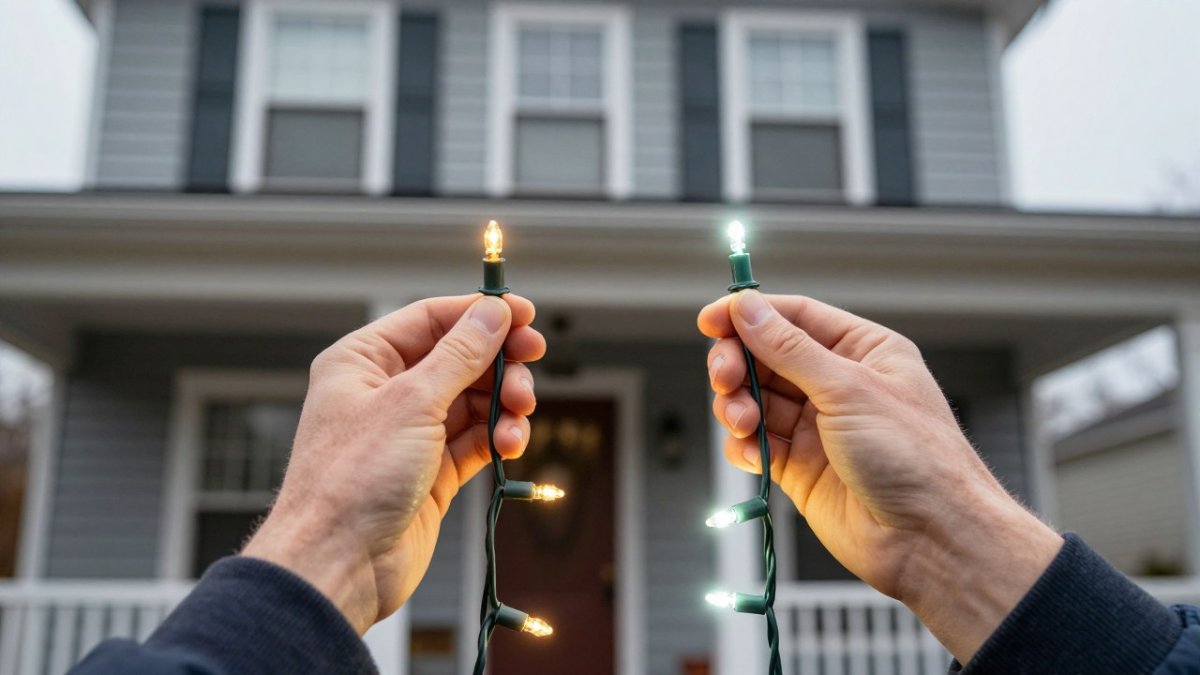
LED Christmas lights electricity usage is dramatically lower than incandescent strands. This is the single biggest reason permanent LED systems pay off over time.
Incandescent bulbs waste most of their energy as heat. Touch a lit incandescent strand and you'll feel it. That heat is electricity you paid for and didn't get as light.
LEDs convert far more of their input into visible light. They also run cool, which matters for safety and for how long the fixtures last.
Here's the practical comparison:
| Factor | Incandescent Strands | LED Permanent System |
|---|---|---|
| Energy use | High, much lost as heat | Low, most becomes light |
| Heat output | Noticeable, warm to touch | Minimal, cool to touch |
| Lifespan | Short, bulbs burn out | Long, diodes last years |
| Annual labor | Install and remove each year | Installed once |
| Replacement cost | New strands every few seasons | Rare |
LED lighting generally uses less energy per unit of light than older bulb types (Saving American Families and Businesses Money through Lighting Efficiency).
What Holiday Lights Cost to Run Across a Full Season
Holiday lights cost to run depends on your schedule, not just your hardware. A display lit for six hours a night for six weeks uses far less than one left on around the clock. The gap between a holiday-only schedule and year-round accent lighting is where most estimates go wrong.
Daily, Monthly and Season-Long Estimates
Build your estimate in three steps. First, get your daily kilowatt-hours. Second, multiply by your rate for daily cost. Third, scale up for the season.
- Daily: total watts × hours ÷ 1,000 × your rate
- Monthly: daily cost × days lit that month
- Season-long: daily cost × total nights in the display window
Here's the same 150-foot, 1-watt-per-foot run from the previous section, at 16 cents per kilowatt-hour, across three realistic schedules:
- Holiday-only (6 hours a night, 45 nights): 0.9 kWh per day, about 14 cents per night, roughly $6.50 for the season.
- Evening accent (4 hours a night, 365 nights): 0.6 kWh per day, about 10 cents per night, roughly $35 per year.
- Overnight (8 hours a night, 365 nights): 1.2 kWh per day, about 19 cents per night, roughly $70 per year.
That year-round figure is the one most guides skip. A permanent system isn't a December expense; it's a small, steady line item every month. Seeing the annual number next to the holiday-only number is what makes the comparison honest.
Your electricity rate is the variable most people miss. Rates vary by utility and by time of day.
The bottom line: a season of LED holiday lighting tends to cost less than a single nice dinner out, and a year of evening accent lighting costs about the same as a few takeout orders.
Monthly electricity cost of a 150-foot permanent LED run by schedule
Standby, Controller and Smart-Control Power You Might Not Count
Standby power is the small draw a system pulls when the lights are off but the controller stays connected. It's easy to forget, and it's real.
Smart controls add convenience and a tiny ongoing load. The controller listens for app commands and keeps your schedules ready.
ENERGY STAR's overview of standby power explains how always-on devices add up across a home. A single controller is minor; a house full of always-on gadgets is not.
How to keep this in check:
- Use the app's schedule so lights aren't left on by accident
- Set a nightly off time you'll actually keep
- Group scenes so one tap handles the whole display
- Check the controller's rated standby figure before you buy
What most guides miss is that the controller is also what saves you money.
If you want to understand how the controller and app fit together, installed once, controlled all year walks through how a permanent system works.
Why Energy-Efficient Holiday Lighting Changes the Year-Round Math
Energy-efficient holiday lighting turns a seasonal expense into a year-round asset. That reframing is where the real savings hide.
A temporary display costs you twice: once for the lights, and again for the labor to hang and remove them.
A permanent system is installed once. After that, the only ongoing cost is the electricity, which stays low thanks to LED efficiency.
There's a safety angle too. Ladder work carries fall risk, and removing that annual climb removes the risk of it.
Then there's the year-round use. It handles holidays, game days, and quiet architectural white lighting on ordinary nights. One permanent system replaces annual holiday installs and storage.
U.S. Department of Energy guidance on LED lighting notes that LED bulbs use less energy and last longer than incandescent options.
That's the shift.
Build Your Own Estimate Before You Commit to an Installation
Build your estimate from four inputs: run length, watts per foot, hours per night, and your electricity rate. That's the whole calculator. Everything else is detail.
Here's a reusable worksheet you can fill in:
- Measure the roofline length you want lit, in feet
- Note the watts per foot for your chosen fixture
- Multiply for total watts
- Decide your typical hours per night
- Find your per-kWh rate on your utility bill
- Calculate daily cost, then scale to the season
- Add a small allowance for controller standby
Run it once for holiday use and once for year-round use. Seeing both numbers side by side is clarifying.
Before you commit, preview the design. You can see it on your home with the online photo visualizer.
When the numbers and the look both work, request your estimate.
A permanent lighting system from Curb Appeal Permanent Lights uses concealed LED fixtures and app-controlled colors, brightness, and schedules. It's installed once and runs year-round, so you skip the ladder work.
Frequently Asked Questions
Do permanent holiday lights use a lot of electricity?
Permanent holiday lights run on LED diodes, which draw a fraction of the power of older bulb types. A typical residential run of a few hundred feet uses far less than most people expect, especially when you schedule it for a few hours per evening instead of all night. The biggest variables are total run length, brightness setting and how many hours per night the system stays on. Check the rated wattage on your controller or product spec sheet, multiply by your hours of use, and divide by 1,000 to get kilowatt-hours.
How much does it cost to run a string of 100 Christmas lights?
Cost depends on bulb type and your electricity rate. LED Christmas lights electricity usage is dramatically lower than incandescent: a 100-bulb LED strand typically draws only a few watts, while an equivalent incandescent strand draws many times more. Multiply the strand's rated watts by your hours of use, divide by 1,000 for kWh, then multiply by your cost per kilowatt-hour from your utility bill. That gives you an exact figure for your own rate rather than a national average.
Do permanent LED lights use electricity when they are off?
They can draw a small amount of standby power through the controller, power supply and any smart-home module that stays connected to Wi-Fi. This is usually a few watts or less, but it adds up over a full year if the controller never fully powers down. If your system has a master switch or a scheduled full-off mode, use it during months you do not light the exterior. Ask your installer whether the controller has a true off state or only a dimmed standby.
What is the most energy-efficient type of holiday lighting?
LED technology is the most energy-efficient option available for holiday lighting. LEDs convert most of their power into light rather than heat, so they use less electricity for the same brightness and run cooler on your roofline. Among LED systems, permanent app-controlled fixtures with scheduling and brightness control tend to use the least energy in practice because you can run them at lower output and turn them off automatically. Compare rated watts per 100 LEDs when shopping, not just the total strand length.
