how-to
How to Plan Exterior Lighting for Game Day Events
Editorial Team · Nov 20, 2026 · 12 min read
Last Updated: November 19, 2026
Quick Summary
Exterior lighting for game day events means using outdoor fixtures, color scenes, and timed controls to turn your home's facade into a visible show of team support. Plan it in four zones: roofline first for team colors, entry and walkway for safety, gathering area for glare-free light, and the screen kept dark.
- LED strip gives a continuous roofline glow, while puck fixtures create spaced scalloped points of light.
- Permanent systems install once and run game day, holiday, and architectural white scenes from one app.
- Keep total fixture load under 80 percent of the breaker rating, roughly 12 amps on a 15-amp circuit.
- Test team colors at dusk from the street, since screen color rarely matches color on siding.
- Set three scenes only: pregame, in-game, and after, so nobody scrolls menus mid-party.
Table of Contents
- Why Exterior Lighting Makes or Breaks a Game Day Event
- Comparing Lighting Types for Game Day Utility
- Outdoor Permanent Lighting: A Year-Round Option
- Game Day Lighting Ideas for Team Spirit
- Team Color Outdoor Lighting Without the Guesswork
- App-Controlled Outdoor Lights and Scheduling
- Safety, Electrical Load, and Neighbor-Friendly Setup
- Preview Your Game Day Lighting Before You Commit
- Frequently Asked Questions
Why Exterior Lighting Makes or Breaks a Game Day Event
Exterior lighting for game day events is the practice of using outdoor fixtures, color scenes, and timed controls to turn a home's facade into a visible show of team support.
The stakes are higher than most people expect. A roofline that glows in team colors signals a watch party from two blocks away.
Below, we break down every lighting type, the layout decisions that matter, and the safety checks to run before the first kickoff.
Comparing Lighting Types for Game Day Utility
Three main options cover most game day setups: LED strip, puck fixtures, and floodlights. Each one solves a different problem, and the right pick depends on whether you want a one-night display or a system that works all season.
| Lighting Type | Best For | Setup Effort | Color Control | Year-Round Use |
|---|---|---|---|---|
| LED strip | Continuous roofline glow | Moderate to high | App or remote | Limited without permanent mount |
| Puck fixtures | Spaced points of light | Moderate | App or remote | Limited without permanent mount |
| Floodlights | Ground-level washes and yard light | Low | Often fixed color | Rental or seasonal |
| Permanent smart system | Full roofline, all events | One professional install | App, scenes, schedules | Yes |
LED Strips and Puck Fixtures
Two fixture styles dominate roofline lighting, and they produce very different looks.
Discrete points of light, spaced along your roofline come from puck fixtures. Each puck casts its own downward cone, creating the classic scalloped pattern many homeowners recognize. One continuous line that traces the architecture comes from LED strip, which runs in a concealed track for a smooth, unbroken glow.
Neither is better in the abstract. Pucks suit traditional homes with defined soffits. Strip suits long, clean architectural lines. Match the fixture to the house, not the other way around.
Floodlights and Temporary Rentals
Rentals solve the short-notice problem. A rental floodlight kit can wash a garage door or front yard in team colors for a single playoff night with no permanent commitment.
The trade-offs are real. Rental units often lock to one color per fixture, so multi-color scenes are out. Setup and pickup add a weekend chore, and placement is limited to where you can safely run power. For a one-time event, that is a fair deal. For a full season of watch parties, the repeated effort adds up fast.
Outdoor Permanent Lighting: A Year-Round Option
Permanent systems install once and stay put, which changes the math on game day lighting entirely. The holiday display is a setting, not a project with a permanent system: the same fixtures handle Christmas, Halloween, the Fourth of July, and every game day in between from one app.
The practical benefit shows up in repetition. A temporary setup costs you a ladder climb before and after each event.
Watch out: a permanent system is only as good as its installation. Concealed wiring and proper fixture spacing are what keep the look clean, and those are hard to fix after the fact.
Game Day Lighting Ideas for Team Spirit
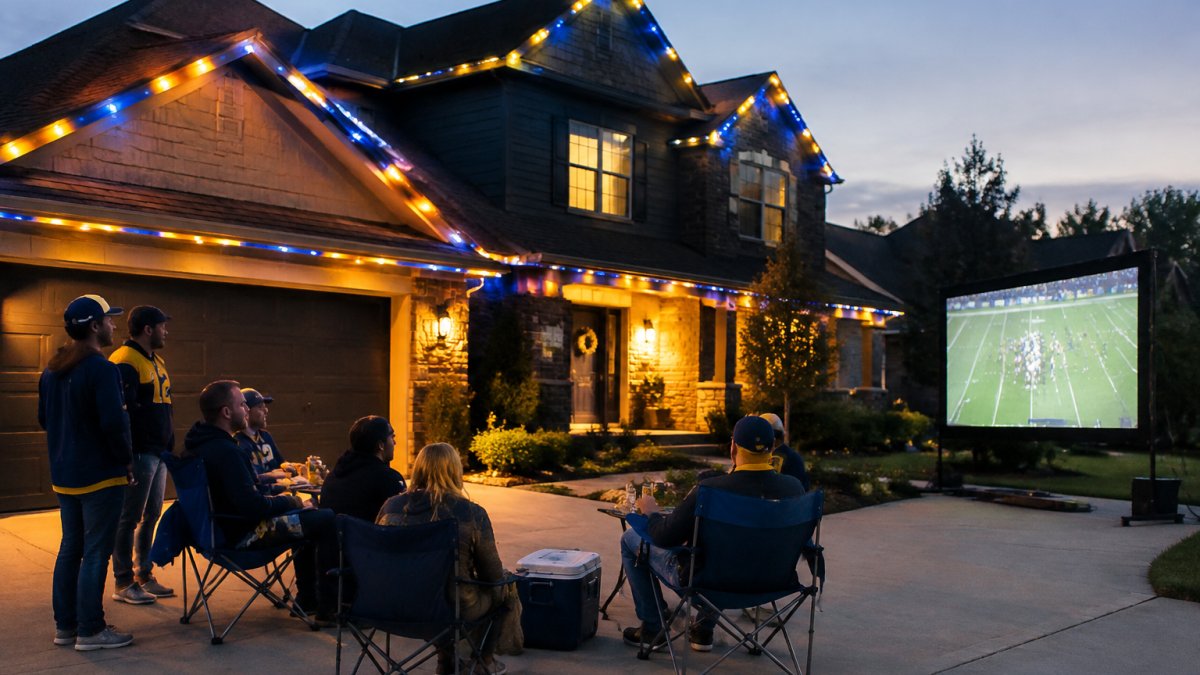
Start with the roofline, then build outward. The most effective game day displays follow a simple hierarchy: outline the architecture first, accent the entry second, and light the gathering space last.
Lay out the display in zones
Treat the exterior as four zones and decide what each one needs before you buy anything:
- Street-facing architecture, roofline, gables, and porch fascia. This is the zone that carries team colors and should be the brightest and most saturated.
- Entry and walkway, the path guests use to arrive. Light it for safety with warm white or a dimmed team color, and keep it lower than the roofline so it does not compete.
- Gathering area, patio, driveway, or lawn seating. Use downward-aimed fixtures or low-level wash so faces and food are visible without glare.
- Screen and focal point, the TV, projector, or outdoor screen. Keep light off the screen surface and out of viewers' eyes; backlight or side-light the area instead of front-lighting it.
A few approaches that work well within those zones:
- Full roofline in team colors for the biggest visual impact from the street
- Two-tone split with one team color on the upper line and the second color on the lower
- Entry accent only for a restrained look that still reads clearly
- Yard and landscape wash to tie the ground level to the roofline
- Post-game switch to white so the house returns to normal the same night
Control glare and keep sightlines clear
Glare is the most common reason a display looks impressive in photos and unpleasant in person.
Watch out: lighting every surface at once flattens the display and creates glare from multiple directions; pick one focal point and let the rest of the exterior stay quiet.
For walkways and steps, light the path rather than the people on it. Low bollards, step lights, or a dimmed wash along the edge of the path give guests visibility without putting a bright source at eye level.
Match the display to the event, not just the team
A regular-season watch party, a playoff game, and a full block party call for different layouts. For a small gathering, roofline color plus a lit walkway is enough. For a larger event, add the gathering-area wash and a separate path light so guests can move safely after dark.
If the display will be used repeatedly, a permanent system makes the layout permanent too: the same zones can be scheduled for pregame, in-game, and after, so the setup that works for one event works for the next without re-aiming fixtures.
Team Color Outdoor Lighting Without the Guesswork
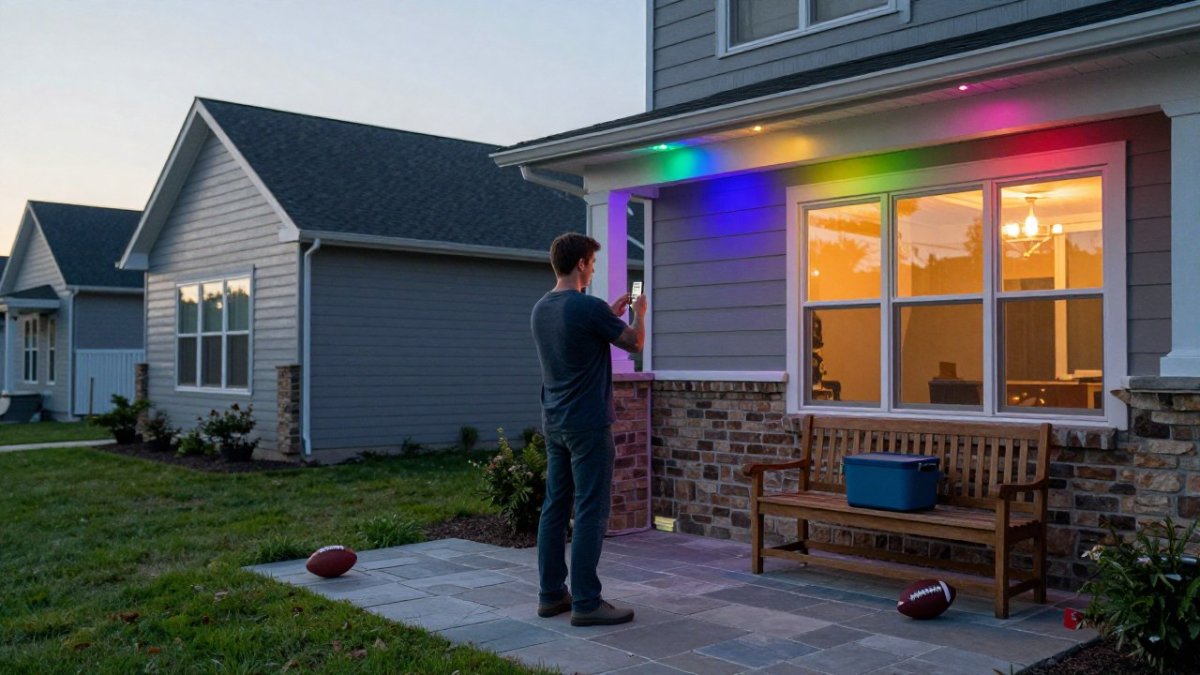
Team color outdoor lighting fails for one reason: the color on the phone screen rarely matches the color on the siding.
A practical fix is to test before the event. Set the scene at dusk, walk to the street, and judge it from where guests will actually arrive.
This is where a preview step saves money. Rather than guessing at a color mix and hoping, you can see the result on your own home first and adjust before anything is installed.
App-Controlled Outdoor Lights and Scheduling
App-controlled outdoor lights turn game day into a scheduled event rather than a manual task. You set the scene once, tie it to a time, and the display runs without you touching a switch.
Scheduling matters more than most people expect. Pregame scenes can start an hour before kickoff, switch to a celebration pattern at scoring moments, and return to architectural white after the final whistle.
For readers who are not tech-comfortable, the practical advice is to set up three scenes and stop there: pregame, in-game, and after. Three buttons cover the whole evening, and nobody gets frustrated scrolling through menus while guests arrive.
Safety, Electrical Load, and Neighbor-Friendly Setup
Safety comes down to three checks: the power source, the weather rating, and the fixture load. Most game day lighting problems trace back to one of those three, and all of them are easier to solve before the first guest arrives than after the first breaker trips.
Power source and circuit capacity
Outdoor receptacles should be GFCI-protected, and that protection should be tested before the event rather than assumed. Press the test button on the GFCI, confirm it trips, and reset it.
Know what else shares the circuit. A garage receptacle that also feeds a refrigerator, freezer, or shop tools has less headroom than an empty dedicated circuit.
Watch out: daisy-chaining multiple power supplies or stringing together more fixtures than the manufacturer allows can overload a circuit even when each individual piece is rated for outdoor use.
Weather rating and wet-weather use
Every fixture, cord, connector, and power supply used outdoors should carry a wet-location rating and a listing mark from a recognized testing laboratory. "Water-resistant" is not the same as "wet-location rated," and a covered porch does not make an indoor-rated product safe for rain.
Plan for weather rather than hoping for it. Check the forecast the day before, and have a shutdown sequence ready: unplug the display at the source, not at the fixture, and bring portable controllers and power supplies indoors if sustained rain or lightning is expected.
Cord routing and trip hazards
Cords are the most common trip hazard at an outdoor watch party, and the fix is routing, not warning signs. Run cords along walls, under mats, or behind planters rather than across walkways, and keep them out of standing water.
Keep fixtures and cords away from grills, fire pits, and space heaters, and confirm that any heat-producing equipment has clearance from fabric, foliage, and siding.
Aim, timing, and neighbor-friendly operation
Neighbor-friendly setup is mostly about aim and timing. Point fixtures down and toward your own property, keep brightness moderate after late games, and switch to white or off by a reasonable hour.
The U.S. Department of Energy's guidance on outdoor lighting is a useful reference for efficiency and light pollution basics, and the Electrical Safety Foundation covers outdoor circuit protection in plain terms.
When you are ready to move from planning to a real installation, request your estimate and share your property details.
Preview Your Game Day Lighting Before You Commit
The single best way to avoid a disappointing display is to see it before you buy. See it on your home with our visualizer: upload a photo of your house, mark the roofline, and choose puck or LED strip lighting with a color theme.
That preview answers the questions that matter most. Will team colors look right against your siding? Does a continuous strip or a scalloped puck line suit your architecture? Does the display read from the street?
Planning a game day display means balancing color, layout, safety, and effort, and the effort is where most homeowners get stuck.
Frequently Asked Questions
What are some good exterior lighting options for game day events?
For a single event, temporary LED floodlights and string lights are the simplest choice, and rental packages can cover a large yard without a permanent install. For repeat hosting, permanent LED systems with app controls let you switch to team colors in seconds and schedule scenes around kickoff. Match the fixture to the job: floodlights for visibility across a viewing area, and roofline or architectural fixtures for color and team spirit.
Can permanent outdoor lights change colors for game day?
Yes. Full-color permanent LED systems let you set team colors, brightness, and schedules from a mobile app. Many app-controlled systems let you save color presets, dim the lights during the game, and return to warm white afterward. Because the fixtures stay mounted year-round, there is no ladder work before each event. Confirm the system supports custom scenes and scheduling before you buy, since not every kit offers the same controls.
How do I light an outdoor viewing area without glare?
Keep light sources out of sightlines. Mount fixtures above or behind the screen and aim them at walls or landscaping rather than at seating. Use dimmable lights and lower brightness during play, then raise it for halftime. A mix of soft ambient light and a few directional fixtures gives visibility without washing out the screen. Test the layout after dark before the event so you can adjust angles and brightness.
What should I check before installing exterior lighting for an event?
Check three things: the electrical load on each circuit, that every fixture is rated for outdoor use, and that cords and connections stay clear of standing water. Use GFCI-protected outlets, keep extension cords off walkways, and secure loose cable so wind cannot pull it down. If you are planning a permanent install, have a professional confirm the layout and wiring so the system holds up through winter weather.
