listicle
7 Benefits of App Controlled Exterior Lighting
Editorial Team · Oct 19, 2026 · 14 min read
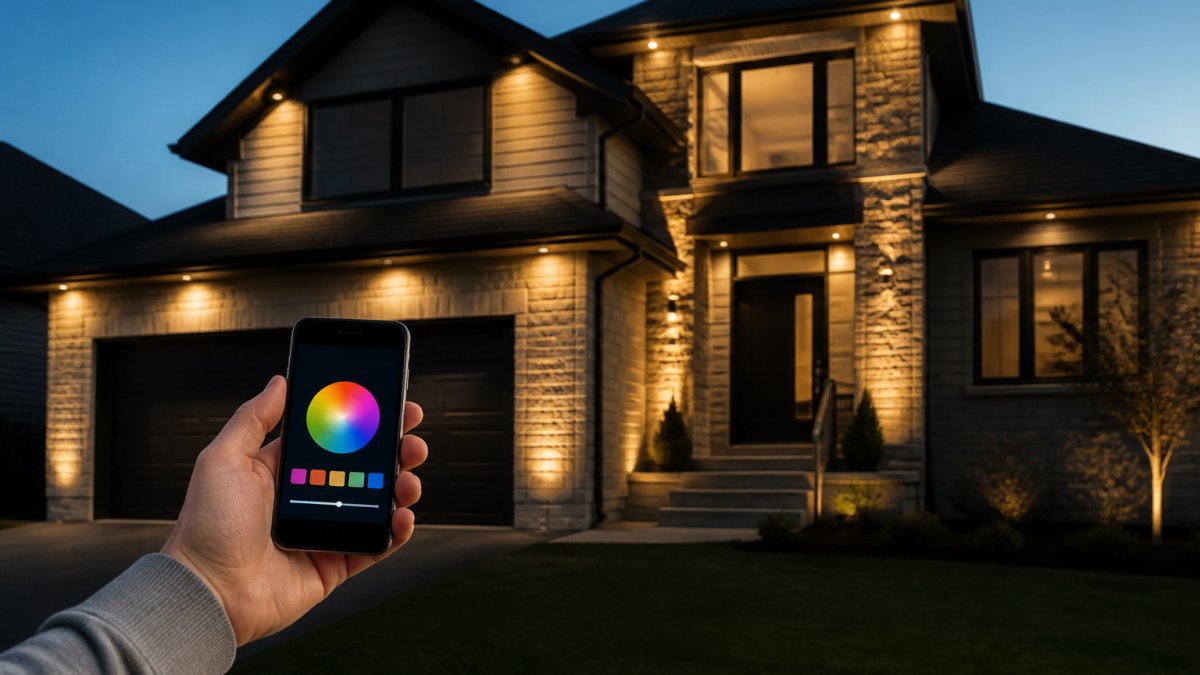
Table of Contents
- 1. Control Every Light From Your Phone
- 3. Outdoor Lighting Schedules and Timers Run Themselves
- 4. Permanent Holiday Lighting Without the November Climb
- 5. Security, Visibility, and Peace of Mind
- 6. Outdoor Lighting Mistakes That Undo the Benefits
- 7. What to Check Before You Buy: Connectivity, Costs, and Reliability
- Frequently Asked Questions
Last Updated: October 19, 2026
1. Control Every Light From Your Phone
The benefits of app controlled exterior lighting start with something simple: every fixture on your property becomes one addressable device on a single screen.
That changes how you actually use your exterior lights. You stop thinking in terms of "on" and "off" and start thinking in scenes. Game day gets team colors along the soffit. A quiet Tuesday gets warm white at low output.
The practical difference shows up in four places:
- Grouping. Lights are bundled into zones (front elevation, driveway, patio) so one tap controls a whole side of the house.
- Dimming. Most systems allow brightness adjustment well below full output, which matters for ambiance and for keeping light where you want it.
- Remote control outdoor lights. You can shut everything off from a phone after you have already left, or turn the porch light on before you pull in.
- Shared access. A well-designed app lets more than one person run the system. You can invite a spouse, a housesitter, or an adult child who checks on the house, and each person gets their own login rather than passing one password around.
Who Actually Uses the App, and Who Shouldn't Have To
A benefit that competitors gloss over is accessibility. Not everyone in a household wants to run exterior lighting from a phone, and a good system does not force them to. Three patterns matter:
- Wall switches and keypads. Most app-controlled systems still tie back to a physical switch or keypad. Someone who does not use a smartphone can turn the lights on the old-fashioned way, and the app schedule picks up from there.
- Voice control as a middle path. A voice assistant lets a household member say "turn on the patio lights" without opening an app or finding a switch. It is often the easiest entry point for guests and older family members.
- Guest and temporary access. If you travel or rent the home seasonally, look for a way to grant temporary app access that you can revoke. A shared login that never changes is a security liability, not a convenience.
A common mistake is buying a system where the app is the only control surface.
At Curb Appeal Permanent Lights, we install concealed fixtures that run along the roofline and stay out of sight during the day.
(/puck-lighting).For anyone who has spent a cold afternoon on an extension ladder, the benefits of app controlled exterior lighting are what sell the system. Everything else is a bonus.
3. Outdoor Lighting Schedules and Timers Run Themselves
Outdoor lighting schedules and timers turn exterior lighting from a chore into a background process. You set the times once, and the system handles the rest, including the parts most people forget.
Sunset Schedules and Daylight Saving Time
A sunset-based schedule triggers lights at whatever time the sun actually goes down at your location, adjusting automatically as the days shorten in fall and lengthen in spring.
Daylight Saving Time is the other trap. A manual timer needs resetting twice a year, and most people remember about a week late.
The result is a house that looks occupied and intentional every night without anyone thinking about it.
4. Permanent Holiday Lighting Without the November Climb
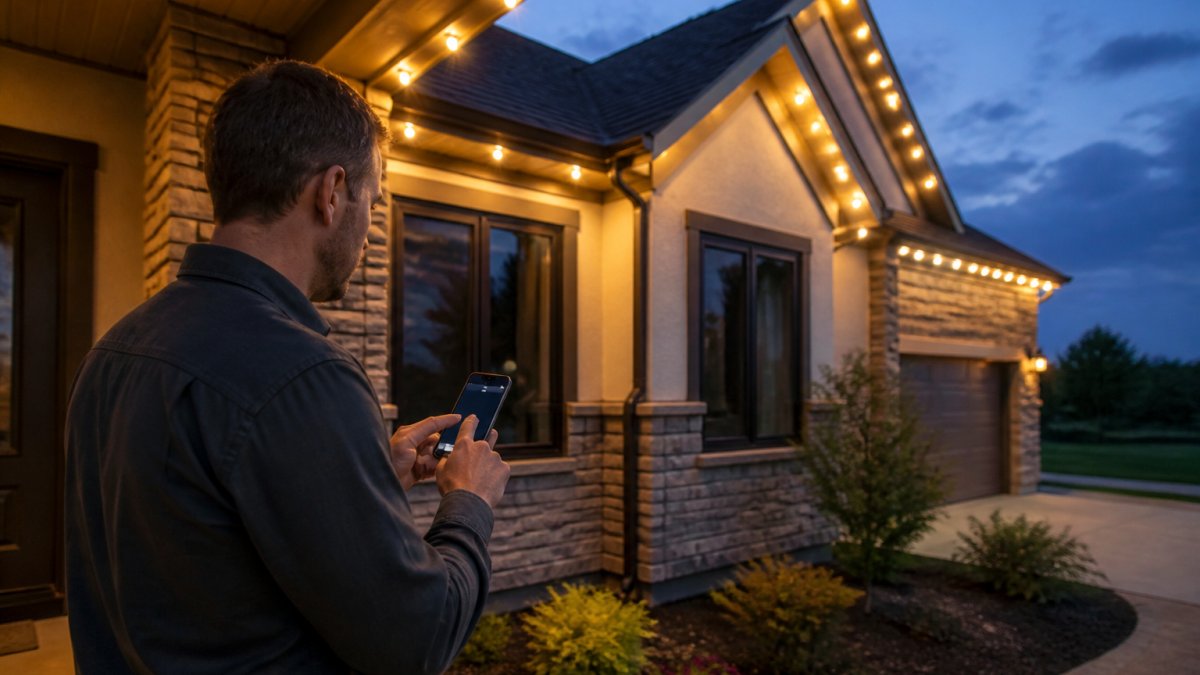
Permanent holiday lighting means the fixtures stay on the house year-round and the holiday look comes from color settings, not from new hardware. The November climb disappears. So does the January teardown, the storage bins, and the annual gamble on whether last year's strands still work.
For classic and traditional homes, the concern is usually whether permanent lighting will look too modern. It comes down to fixture selection and placement.
Curb Appeal Permanent Lights offers an online photo visualizer for exactly this reason: you upload a picture of your house and see how the lighting design reads on your elevation before anyone drills a hole.
5. Security, Visibility, and Peace of Mind
Security lighting works best when it is predictable and layered. A dark house with one motion-triggered floodlight announces every arrival to the whole street. A house with steady, low-level exterior lighting plus targeted motion response looks occupied and gives you visibility without the glare.
App control adds two things a plain photocell cannot. First, you can check and adjust lights remotely, which matters when you are traveling or when a neighbor texts that something looks off.
Motion Sensors and Automated Responses
Motion sensors and automated responses pair well with app-controlled systems. A sensor on the driveway can trigger a brighter scene for a few minutes, then return to the baseline schedule. That gives you the visibility you want at the moment you need it, without running full brightness all night.
The honest caveat: motion automation is only as reliable as your network and your settings. Test the response time and the return-to-baseline behavior before you rely on it.
6. Outdoor Lighting Mistakes That Undo the Benefits
Outdoor lighting mistakes usually fall into four buckets, and each one erases a benefit you paid for.
| Mistake | What Goes Wrong | The Fix |
|---|---|---|
| Too much brightness | Glare, washed-out facade, annoyed neighbors | Dim to the lowest level that still reads as lit |
| No zoning | Whole house blasts on for one late arrival | Group fixtures by area and schedule each zone separately |
| Ignoring light spill | Light trespasses onto neighboring property | Aim fixtures downward and keep output modest after late evening |
| Weak Wi-Fi at the controller | App commands lag or fail | Check signal strength at the install point before committing |
Light pollution and neighbor-friendly design deserve their own mention. Exterior lighting that throws light sideways or upward is the fastest way to sour a relationship with the people next door. Downward-aimed, dimmable fixtures solve most of it.
7. What to Check Before You Buy: Connectivity, Costs, and Reliability
Compatibility and connectivity decide whether the app is a convenience or a frustration. Before you buy, confirm the following:
- Network requirements. Does the controller need 2.4 GHz Wi-Fi, and is that signal strong where the controller will live? Exterior walls, stucco, brick, and metal siding all cut signal, so "the router is in the living room" is not the same as "the controller has a reliable connection." Ask the installer to test signal strength at the actual mounting point, not at the front door.
- Hub or bridge dependency. Some systems talk directly to Wi-Fi; others need a hub or bridge wired to the router. A hub adds a point of failure and a place to lose power, but it can also extend range and keep schedules running locally. Know which architecture you are buying.
- Bluetooth vs. Wi-Fi range. Bluetooth-only fixtures are simple to set up but usually need you within close range to control them. For a whole-house install, Wi-Fi or a hub-based system is the more practical choice.
- Voice control and smart-home integration. Confirm which voice assistants and routines the system supports, and how deep the integration goes. "Works with" can mean full scene control or just on/off.
Total Cost of Ownership and Payback
Pricing for app-controlled exterior lighting depends on roofline length, fixture count, controller count, and site conditions, so any per-foot or per-fixture number you see online is a starting point, not a quote. What you can compare is the structure of the cost:
- Fixtures and controller. The hardware is the largest single line item. Concealed track systems and surface-mounted pucks price differently, and the controller count scales with the size of the install.
- Installation labor. Roofline height, roof pitch, and access all affect labor. A two-story elevation with steep pitch costs more to wire than a single-story ranch.
- Subscription or app fees. Some systems include app control in the purchase price; others charge a recurring fee for scheduling, scenes, or cloud features. Ask directly whether the app is free forever or free for a trial period.
- Energy. LED fixtures draw far less than incandescent strands, and dimming and scheduling cut consumption further. Usage monitoring in the app, where available, shows what you are actually spending.
A common pattern is that the installed cost looks high next to a string of lights from a big-box store, and looks reasonable next to a decade of paying for seasonal installs. Run both comparisons before you decide.
What Happens When the Internet Goes Down
This is the question most buyers forget to ask, and it separates a well-engineered system from a toy. Ask the installer three specific things:
- Does the schedule run locally? A good controller stores the schedule on the device, so lights still turn on at dusk even if the cloud service is unreachable.
- Is there a physical override? You want a switch or keypad that works without the app, the account, or the network.
- What happens after a power loss? The controller should come back online and resume its schedule without a manual reset. If it needs a ladder to reboot, that is a design flaw.
Curb Appeal Permanent Lights handles the connectivity check as part of the site assessment, because a beautiful install with a weak signal is a system you will stop using.
Frequently Asked Questions
What are the benefits of app controlled exterior lighting?
The main benefits of app controlled lighting come down to control, convenience, and customization. You can turn lights on or off from anywhere, set brightness and color, and schedule everything to run automatically at sunset. That means no ladder work, no forgotten switches, and no leaving lights blazing all night. You also get scene changes for holidays and game days, plus motion-triggered responses that help with security.
Can you schedule outdoor lights from a phone?
Yes. Most app-controlled systems let you build schedules that follow sunrise and sunset, so your outdoor lighting schedules and timers adjust as the days get shorter or longer. You can also set separate schedules for weekdays and weekends, or create a vacation mode that makes the house look occupied. Many apps update automatically for Daylight Saving Time, which removes one more thing to remember each spring and fall.
Can app-controlled exterior lights change colors for holidays and events?
Color customization is one of the biggest draws of permanent holiday lighting. A single installed system can switch from warm architectural white on a normal evening to red and green in December, team colors on game day, or orange in October. You typically save scenes in the app, so changing the look of your home takes a few taps instead of a ladder and a fresh set of bulbs.
What are common outdoor lighting mistakes to avoid?
Three mistakes show up again and again. First, pointing fixtures outward or upward so light spills onto neighbors and creates glare. Second, over-lighting a facade until it looks like a parking lot rather than a home. Third, skipping a walkthrough of the plan, which is why previewing a design on your own home before installation matters. Aim for a subtle wash of light, group fixtures into zones, and use dimming rather than full brightness after dark.
Exterior lighting only pays off when it runs itself, looks right on your specific house, and stays reliable through a Michigan winter. That is the standard we build to at Curb Appeal Permanent Lights: concealed permanent LED fixtures, app-controlled color and brightness, sunset-based scheduling, and a photo visualizer so you can see the design on your own home before installation. Get started with Curb Appeal Permanent Lights and see it on your home first.