blog
Are Permanent Holiday Lights Worth It? A 2026 Cost Guide
Editorial Team · Oct 16, 2026 · 14 min read
Table of Contents
- Are Permanent Holiday Lights Worth It? The Honest Math
- What Permanent Holiday Lights Cost: Upfront and Long-Term
- Permanent Christmas Lights Pros and Cons
- Permanent Holiday Lights vs. Traditional Christmas Lights
- Permanent Outdoor Lights Lifespan, Durability, and Maintenance
- DIY vs. Professional Installation: Climate, Roof, and Warranty
- Do Permanent Holiday Lights Increase Home Value?
- Frequently Asked Questions
Last Updated: October 16, 2026
Are Permanent Holiday Lights Worth It? The Honest Math
Permanent holiday lights are a fixed, professionally installed LED system that stays on your home year-round, so you never hang or remove string lights again.
The upfront cost is real and higher than one season of temporary lights; the value shows up over years.
Below, we break down the real cost drivers, pros and cons, and the questions most guides skip.
What Permanent Holiday Lights Cost: Upfront and Long-Term
Permanent holiday lights cost more upfront than a single season of temporary lights, but the gap narrows over time. Most cost guides either hide behind "request a quote" or throw out a national average that does not match your house. Here is the transparent version, with assumptions spelled out so you can plug in your own numbers.
What Drives the Upfront Installation Cost
Several factors decide your quote:
- Linear feet of roofline and eaves. More track means more fixtures and labor. This is the single biggest driver.
- Stories and roof pitch. Steep, tall roofs need more setup, safety gear, and often a second crew member.
- Fixture type. Concealed puck lights, LED strips, and track-mounted bulbs sit in different price tiers.
- Controllers and app hardware. Smart controls, scheduling, and music sync add cost.
- Access and obstructions. Dormers, gables, chimneys, and tight landscaping add labor hours.
- Electrical. An existing exterior outlet near the roofline keeps cost down; a new circuit or GFCI outlet adds an electrician's visit.
As a planning range, pricing depends on quantity, dates, and delivery. Treat these as budgeting brackets, not quotes.
A U.S. Department of Energy guide to LED lighting notes that LED fixtures use far less power than older incandescent bulbs, which matters for the long-term side of the ledger.
Long-Term Cost: Energy, Repairs, and Payback Period
Ongoing costs are small compared with the install, but not zero. Here is how to estimate them.
Electricity. LED permanent systems are low-draw. A common configuration runs a few watts per fixture, so a 150-foot roofline might draw 50 to 150 watts total while lit.
Repairs and service. Budget for occasional fixture or controller replacement.
Payback math. Add up what you spend each year on temporary lights:
- New or replacement strands: often $50 to $300 per year depending on roofline size.
- Clips, extension cords, and timers: $20 to $75 per year.
- Paid hanging and removal labor: commonly $200 to $800 per season for a single-story home, more for two stories or steep roofs.
- Storage: boxes, bins, and garage or basement space.
A household that pays for hanging and removal plus replacement strands annually can see the value of a permanent system over time.
How to Compare Quotes Apples to Apples
When you collect quotes, make sure each covers the same scope, or the cheapest bid will look better than it is:
- Linear feet of roofline included, and whether gables and dormers are extra
- Fixture type and count per foot
- Controller and app included, and whether the app has a subscription fee
- Warranty length and what it covers (fixtures, controller, labor)
- Whether removal and reinstallation are included if you re-roof or sell
- Electrical work: is a new outlet or circuit included or billed separately?
A low bid that excludes the controller, the outlet, or the labor warranty is not actually cheaper. It is a smaller job.
Permanent Christmas Lights Pros and Cons
Permanent Christmas lights trade a higher upfront price for years of convenience, safety, and control. The pros are practical. The cons are mostly about money and commitment.
Pros:
- No annual hanging, removal, or storage
- No ladder work in cold or icy conditions
- App control for colors, brightness, and schedules
- Year-round use for holidays, game days, and events
- Discreet fixtures that blend with the roofline
Cons:
- Higher upfront cost than temporary strands
- Professional install is a commitment, not a quick swap
- You need a provider you trust for service and repairs
- Cheap installs can look uneven or fail early
The deciding factor for most homeowners is time. If you enjoy hanging lights, keep doing it. If you dread it, the convenience is worth real money.
Permanent Holiday Lights vs. Traditional Christmas Lights
Permanent holiday lights stay installed year-round, while traditional Christmas lights go up each fall and come down each winter. That difference drives everything else: cost, time, storage, and safety.
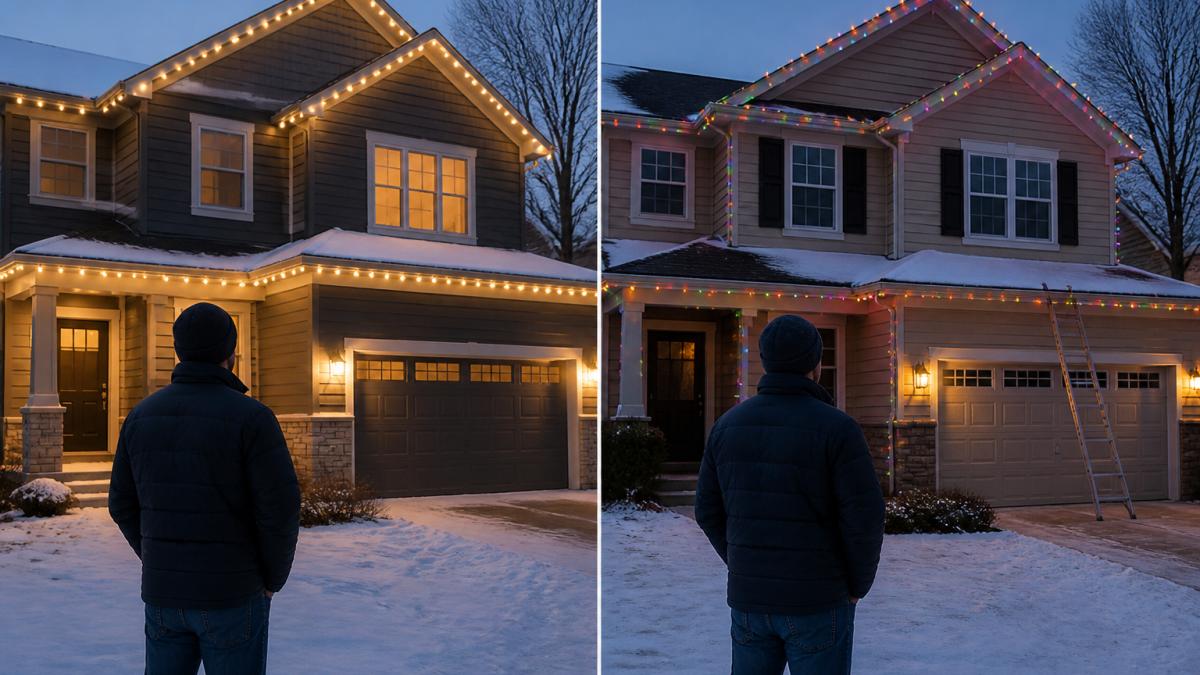
Permanent systems remove all three. You set the schedule once and forget the ladder.
| Factor | Permanent Lights | Traditional Lights |
|---|---|---|
| Upfront cost | Higher, one-time | Lower, recurring |
| Annual labor | None | Hours each season |
| Storage needed | None | Boxes every year |
| Ladder risk | None after install | Every season |
| Year-round use | Yes | No |
Permanent Outdoor Lights Lifespan, Durability, and Maintenance
Permanent outdoor lights typically last many years when the fixtures, wiring, and install are quality. But "many years" is not a specification. Here is what determines whether your system is still running in year ten or failing in year three.
What Actually Determines Lifespan
Ingress protection (IP) rating. This standard tells you how well a fixture keeps out dust and water.
LED driver and controller quality. The LEDs often outlast the electronics driving them.
Mounting method. This is the durability decision homeowners underestimate most:
- Adhesive and clips are fast and cheap but degrade with UV, heat, and freeze-thaw cycles, the most common cause of sagging strands and callbacks.
- Screwed clips or brackets hold up far better and are the standard for professional installs.
- Aluminum track or channel is the most durable and expensive, gives the cleanest look, and protects wiring from direct weather.
The mounting method also determines whether the system can be removed cleanly later, important if you re-roof or sell.
Roof material and climate exposure. Asphalt shingle, metal, tile, and cedar all take fasteners differently, and some are fragile under foot traffic.
What Maintenance Actually Looks Like
Maintenance on a quality system is light, but not zero:
- Post-storm checks. After severe wind, ice, or hail, walk the roofline for sagging sections or displaced clips.
- Seasonal app check. Confirm schedules and scenes still fire, especially after a power outage or firmware update.
- Connector inspection. Every year or two, have connectors checked for water intrusion, this is where preventive maintenance pays off.
- Fixture replacement. Individual failed fixtures should be swappable without cutting the run. Confirm this before you buy.
A common mistake is choosing the lowest bid, then paying twice when strands fail. Buy once, install right.
Warranty and Serviceability: The Fine Print That Matters
Warranty terms vary widely, and the differences matter more than the headline length:
- What is covered. Fixtures only? Controller? Labor? A "10-year warranty" covering parts but not the labor to reach them is worth far less than a shorter warranty that includes service.
- Who honors it. A manufacturer warranty you ship parts for is different from an installer warranty that sends a crew.
- Transferability. If you sell the home, does the warranty transfer to the buyer? This affects resale value.
- Service availability. Is there a local provider who will service the system, or is the installer the only option? If the installer goes out of business, who fixes it?
Ask your installer how individual fixtures are replaced, what the connector IP rating is, and whether the warranty covers labor. Good systems let a single failed light be swapped without tearing out the whole run, and good installers will answer all three without hesitation.
DIY vs. Professional Installation: Climate, Roof, and Warranty
DIY permanent lighting is possible, but it rarely matches a professional install for looks or lifespan. The kits exist, and a handy homeowner can mount them.
The hard part isn't the lights. It's the roof access, wire routing, and weather sealing. A rushed DIY job can leak, sag, or fail in the first cold snap.
Professional installation also brings a warranty and a service path. If something fails, you call someone. With DIY, that someone is you, on a ladder, in January.
Do Permanent Holiday Lights Increase Home Value?
Permanent holiday lights can support resale value by improving curb appeal, though they are not a guaranteed dollar-for-dollar return. Real estate guidance from the National Association of Realtors on curb appeal consistently ranks exterior appearance among the top factors in a buyer's first impression.
The bigger question is portability. If you move, can the system come with you? Many systems can be removed and reinstalled, but that depends on the mounting method and your siding.
For homeowners planning to stay, the value is simpler: a home that looks great every night, with no seasonal work. For sellers, it is a selling point, not a windfall.
Frequently Asked Questions
What are the downsides of installing permanent Christmas lights?
The main drawbacks are the upfront cost, which is higher than one season of temporary lights, and the fact that the fixtures stay on your home year-round. Some homeowners find the visible channel along the roofline less clean than bare wire. Repairs can also be harder to DIY because the system is wired in sections. Finally, if you sell the house, the next owner inherits the look whether they want it or not. None of these are dealbreakers, but they are worth weighing before you commit.
How long do permanent holiday lights last?
Quality permanent outdoor lights lifespan runs roughly 10 to 15 years, though LED diodes themselves are often rated for 50,000 hours or more. What usually fails first is not the bulb but the connection points, the adhesive or mounting clips, and the power supply. Weather exposure, freeze-thaw cycles, and roof heat all shorten that window. Systems installed under the eaves and behind the fascia tend to outlast exposed runs, and a warranty that covers labor, not just parts, matters as much as the rating.
Do permanent holiday lights increase home value?
There is no reliable dollar figure tying permanent lighting to resale value, and any specific percentage you see quoted is an estimate rather than an appraisal. What permanent lighting does affect is curb appeal, which is one of the factors buyers and their agents notice on a listing photo. A clean, evenly lit exterior photographs well and signals a maintained property. Treat the value as a presentation advantage rather than a guaranteed return, and keep documentation of the installation for the next owner.
Can permanent outdoor lights be used year-round?
Yes, and that is the point of the system. Most setups run warm white architectural lighting on ordinary nights, then switch to color scenes for holidays, game days, and events through a mobile app. Scheduling and brightness controls let you dim the output so it reads as accent lighting rather than a holiday display. Year-round use is also what makes the upfront cost easier to justify, since the lights work every night instead of six weeks a year.
The real challenge with permanent holiday lights isn't the technology. It's deciding whether the upfront cost beats years of seasonal hassle. At Curb Appeal Permanent Lights, we make that decision easier with a photo visualizer that shows how the system looks on your own home before you commit, app-controlled colors and schedules, and discreet fixtures that blend with your roofline. Get started with Curb Appeal Permanent Lights and see your home lit the way you want, every night of the year.